

Reviewed · WALKING TOURS
Dublin Walking Hibernoceltic Tours
Few cities tell their story better on foot.
This Dublin Walking Hibernoceltic Tours route is built for people who like lesser-seen streets and real architecture, not just the famous photo stops. I especially like that you get guided time at Dublin Castle and the old city wall gate area, with admission included, and that the storytelling is anchored by guide Barry O’Brien (Finbarr, Barry), praised for warmth and for taking questions. One thing to consider: overall timing is longer than the pure guide time, and you will be walking a good chunk of the morning.
What you’re really buying here is a guided thread through multiple eras, from medieval Dublin up through Georgian power and right into the 1916 rebellion story. With a maximum of 15 travelers, you can ask questions and keep the pace comfortable. Also, the tour ends in a different location, so you’ll want to plan your next stop accordingly.
In This Review
- Key Highlights at a Glance
- Entering The Day: Small Group, Big Walking Route
- Dublin Castle Grounds (Stop 1): Admission Included, And Why It’s Worth It
- St Audoen’s Church (Stop 2): The Only Still-Operating Medieval Church Feel
- Old City Wall Gate From 1240 AD (Stop 3): The Stairway To Heaven
- Dame Street and Grattan’s Parliament (Stop 4): Politics as Architecture
- Trinity College Grounds: Learning That Dates Back Over 430 Years
- Leinster House and the Georgian Southside Effect
- Merrion Square: A Georgian Square With Oscar Wilde in the Middle (Stop 5)
- O’Connell Street and the General Post Office: 1916 Up Close (Revolutionary Stop)
- Garden of Remembrance and Hugh Lane Art Gallery (Revolutionary Stop)
- North Great Georges Street, Tenements, and Joyce Country
- Price and Value: When $30.23 Feels Like It Adds Up
- Who This Tour Suits Best
- Booking Advice: When to Say Yes and How to Make It Work
- FAQ
- FAQ
- How much does the Dublin Walking Hibernoceltic Tours tour cost?
- What time does the tour start?
- How long is the tour?
- What group size should I expect?
- Is the tour offered in English?
- Do I need to print a ticket?
- Which stops have admission tickets included?
- Is coffee or tea included?
- Where does the tour end?
- Can I join if I have accessibility concerns?
- What is the cancellation policy?
Key Highlights at a Glance
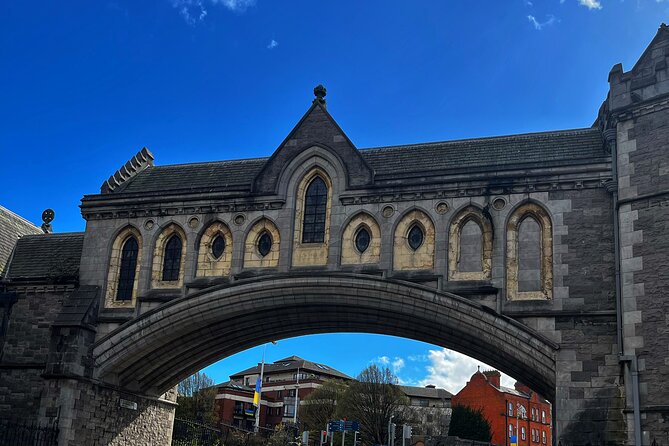
- Dublin Castle grounds included for a real sense of how power and defense shaped the city
- St Audoen’s Church visited for the feel of the only remaining medieval church still operating in Dublin
- Old City Wall gate from 1240 AD, with the passageway into the Old Medieval City called the Stairway to Heaven
- Georgian Dublin landmarks tied to politics, including Grattan’s Parliament and the Custom House
- Merrion Square and Oscar Wilde’s monument, plus classic Georgian square planning
- O’Connell Street to 1916 sites, including the General Post Office and the Garden of Remembrance
Entering The Day: Small Group, Big Walking Route

This is a guided walking tour starting at 10:00 am. The total listed duration is about 2 hours 40 minutes. The tour time itself is 1 hour 10 minutes, with the rest of the time taken up by travel and walking between points.
That time split matters. If you’re trying to stack this with other plans, treat it like a half-morning walking activity. Wear shoes you trust. You’ll be on city sidewalks and at several sites where you’ll pause for the guide’s explanation.
The group cap is 15 travelers, so you are not lost in a crowd. You also get the advantage of a guide who is described as warm, welcoming, and willing to give time for questions. In practical terms, that means you can steer the conversation a bit, especially if something the guide points out catches your eye.
More of Dublin crossed at walking pace:
Dublin Castle Grounds (Stop 1): Admission Included, And Why It’s Worth It
Your route begins at Dublin Castle. You’ll walk the grounds with your guide and get context for how it developed, how it’s laid out, and why it mattered culturally and politically.
The value here is simple: you get an admission ticket included for this stop. Dublin Castle is one of those places where the architecture and the layout do a lot of the teaching. If you only view it from the outside, you miss the built-in story the complex tells about authority, control, and changing eras.
Time on this stop is listed at about 20 minutes. That’s enough to see the major points the guide wants you to notice without turning it into a rushed sprint.
What to watch for:
- How the grounds and buildings feel defensive and administrative at the same time
- Details that help you connect later stops in the day, like Georgian government buildings and Parliament-era stories
St Audoen’s Church (Stop 2): The Only Still-Operating Medieval Church Feel
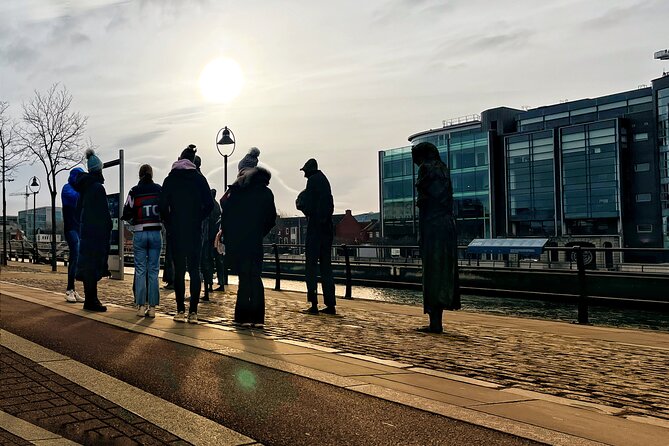
Next comes St. Audoen’s Church, visited for about 10 minutes. This stop is special because it’s dedicated to St. Audeon and is described as the only remaining medieval church still operating in Dublin.
That matters because the atmosphere is different from a museum-style site. You get a living sense of the medieval city, not just ruins behind glass. Admission is free here, so you can spend your budget elsewhere in the day.
The main drawback is also the tradeoff: the stop is short. It is designed as a quick, focused step in the medieval chain of the itinerary, not a deep visit where you can wander for an hour.
Old City Wall Gate From 1240 AD (Stop 3): The Stairway To Heaven
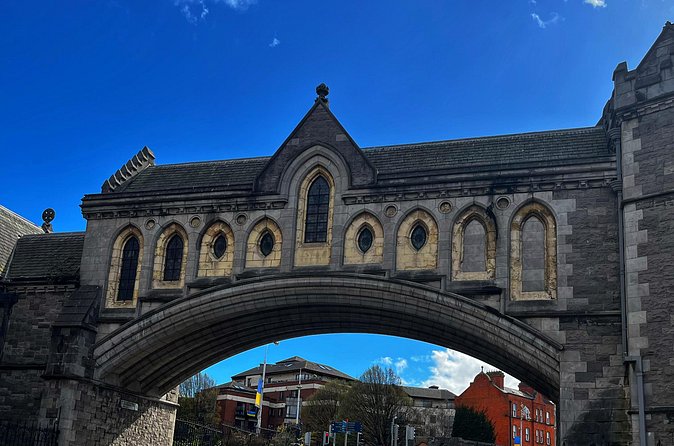
Then you move into what the tour frames as the medieval core: the Old Dublin City Wall, specifically the last remaining gate dating back to 1240 AD. Your guide takes you to that gate area and the passageway into the Old Medieval City, known as the Stairway to Heaven.
This is a strong stop for two reasons. First, it’s concrete. You’re standing at something tied to an older Dublin street plan and older defensive logic. Second, the tour includes an admission ticket for this stop.
Time is about 5 minutes, so the guide will likely focus on what to look for at the gate and entry passage rather than letting you drift. It’s best if you treat this as a quick landmark moment, then keep your questions ready for the next discussion points.
Practical note: if you are sensitive to uneven, older-feeling ground, keep an eye on your footing around gate areas and passage entrances.
Dame Street and Grattan’s Parliament (Stop 4): Politics as Architecture

From the medieval phase, you shift into Georgian-era power along Dame Street. The highlight here is the Old Irish Parliament, built in the early eighteenth century and locally known as Grattan’s Parliament.
This stop is free, and it’s only listed at 5 minutes, but it sets up a bigger idea for the day. The guide connects the building’s demise at the start of the nineteenth century to underlying causes of the Great Famine. Even if you already know the famine story, the value is in seeing how political shifts and civic decisions can show up as physical change in the city.
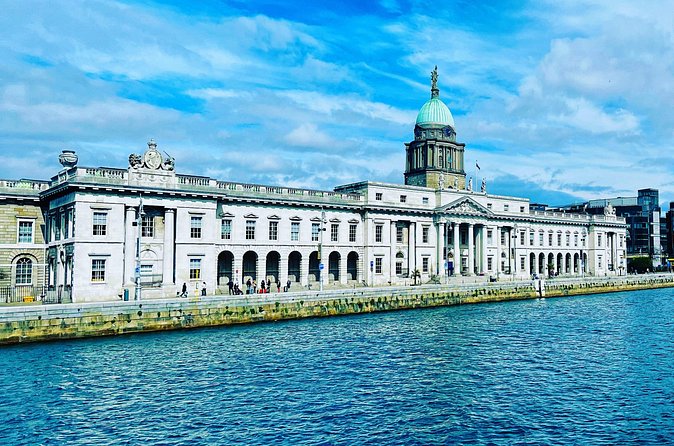
The Custom House pass also fits this theme. You’ll pass the Custom House along the River Liffey, described as the most striking example of Georgian architecture in Dublin. You don’t get a dedicated time block here, so don’t expect a full deep explanation. Think of it as a moving postcard with a guided caption.
Another way the same day could go from Dublin:
- Dublin to Cliffs of Moher, including Wild Atlantic Way and Galway
★ 5.0 · 23,331 reviews - From Dublin: Cliffs of Moher, Burren & Galway City Day Tour
★ 4.8 · 18,888 reviews - Dublin: Guinness Storehouse Entry Ticket
★ 4.6 · 16,863 reviews - Dublin to Cliffs of Moher, Burren, Wild Atlantic Way, Galway Tour
★ 5.0 · 12,924 reviews
Trinity College Grounds: Learning That Dates Back Over 430 Years
Next, you walk through the grounds of Trinity College, with your guide sharing the history of Ireland’s oldest university dating back over four hundred and thirty years.
This is one of those Dublin stops where you get a lot of payoff with relatively little time. The “grounds” focus matters, because you’re not stuck only at a single building. The guide can connect the university to broader Irish identity and learning, and you can quickly pick up the feel of how the area sits within the city.
This also helps pace the tour. After government buildings and political architecture, Trinity College gives you a shift toward institutions tied to learning and long-term influence.
Leinster House and the Georgian Southside Effect
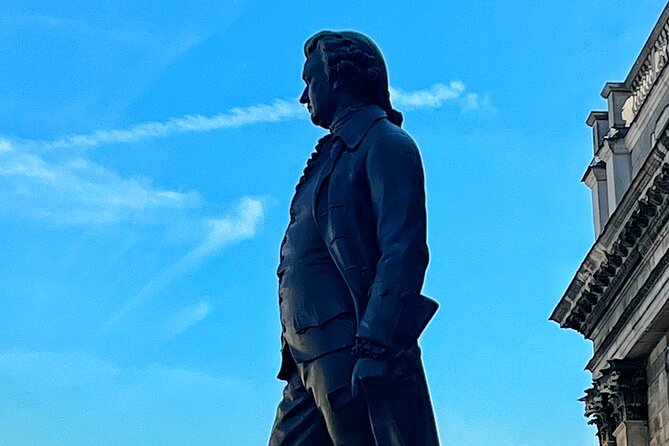
Your route includes a stop at Leinster House, a building dating back to the 1740s, and the location of Ireland’s National Parliament, the Dáil. You learn about its history and architecture, plus how it influenced the building of the Georgian Southside.
This is a key interpretive stop. It connects why Georgian Dublin looks the way it does. The guide’s job is to help you see the city as something planned, not accidental. Even if you have never toured Dublin’s Georgian streets before, this is where the “why” clicks.
It’s also part of why the tour works for different interests. If you’re into architecture, it’s a building lesson. If you’re into politics and history, it’s a system lesson.
Merrion Square: A Georgian Square With Oscar Wilde in the Middle (Stop 5)

Merrion Square is where the tour gives you a longer pause, listed at about 20 minutes. The guide describes it as the finest example of a Georgian square in Dublin, with its Jardin Anglaise style, and you visit the monument to novelist and playwright Oscar Wilde.
This stop is free, and it’s a great place to slow down and read the city instead of rushing through it. Georgian squares have a specific logic, and Merrion Square is meant to show you that layout in a clean, recognizable way.
The Wilde connection also helps. It’s not just a statue for photo value. It gives your guide an opening to talk about Irish literary influence and how Dublin’s cultural life has long roots.
O’Connell Street and the General Post Office: 1916 Up Close (Revolutionary Stop)
As the tour shifts into revolutionary themes, you move along O’Connell Street, where you pass The General Post Office (G.P.O.). The GPO is described as the last of the great Georgian buildings of Dublin and also as headquarters of the 1916 Rebellion.
This is where history becomes immediate. The guide’s job here is to connect the building’s role to the street around it, so you can see how major events use visible, central spaces.
The practical advantage of a walking tour at this point is that you’re not trapped inside a single building. You’re learning the story while you look at the urban stage the story happened on.
Garden of Remembrance and Hugh Lane Art Gallery (Revolutionary Stop)
You then visit the Garden of Remembrance, tied to the Irish Volunteers who were held overnight after surrendering to the British Forces. This is listed at 10 minutes, and it’s free.
From there, you pass the Hugh Lane Art Gallery on Parnell Square, described as housing fine examples of Impressionist and early twentieth-century art.
This is a good pairing because it balances commemoration with culture. The Garden of Remembrance gives you a solemn sense of a specific moment. The art gallery pass reminds you that Dublin also built a serious cultural scene alongside its political upheavals.
North Great Georges Street, Tenements, and Joyce Country
Another guided stretch brings you along North Great Georges Street, described as one of the finest examples of Georgian Dublin. Here, the guide talks about late nineteenth and early twentieth-century tenements and what living conditions were like for many residents.
You then pass the James Joyce Centre, which celebrates James Joyce. The tour notes that his novel Ulysses describes a day in Dublin and is reputed to be the birth of the modern novel.
This is an effective finale zone because it’s less about a single monumental event and more about daily life and the people who lived in the city’s apartments. It also ties literature back into place, which is exactly how Dublin feels when you connect the dots.
Price and Value: When $30.23 Feels Like It Adds Up
At $30.23 per person, the headline price looks reasonable for Dublin. The real question is what you get for it, and here you get a strong mix.
You are not only paying for walking and talking. You also get admission included at Dublin Castle and at the Old City Wall gate passageway area. Several other key stops are free, including St. Audoen’s Church, Grattan’s Parliament area, Merrion Square, and the Garden of Remembrance.
You also get a small group size, plus a guide profile that is praised for being warm, generous with time, and open to questions. That kind of guide attention can make a short stop feel longer, because you get the context you would otherwise have to read later.
One cost you should plan for: coffee and/or tea are not included. If you want a break, plan to grab one at your own expense nearby, and bring water if you know you get thirsty while walking.
Who This Tour Suits Best
This is a great fit if you:
- Like architecture and want it explained in plain language
- Want a guided route that connects medieval, Georgian, and 1916 stories in one morning
- Prefer smaller groups, where you can ask questions
- Enjoy the kind of Dublin that feels lived-in, not only curated for cruise crowds
It’s also a solid choice if your trip time is tight. The tour covers a lot of major areas, including Dublin Castle, Trinity College grounds, Leinster House, Merrion Square, the GPO, and the Garden of Remembrance, without needing separate tickets for every stop.
Booking Advice: When to Say Yes and How to Make It Work
I’d book this if you want a guided “through-line” across eras, with enough time at key places like Dublin Castle and Merrion Square to really see what the guide points out.
Say yes especially if you:
- Enjoy asking questions
- Want your time used well, including admission value
- Like a route that moves past the biggest headlines to show the streets and structures behind them
Before you go, do one simple thing: plan your next stop because the tour ends in a different location. Also, keep your expectations aligned with the pace. Some stops are quick, like 5 to 10 minutes, because the itinerary is designed to cover a lot of ground.
FAQ
FAQ
How much does the Dublin Walking Hibernoceltic Tours tour cost?
The price is $30.23 per person.
What time does the tour start?
The start time is 10:00 am.
How long is the tour?
The total duration is about 2 hours 40 minutes. The tour time is listed as 1 hour 10 minutes, and the rest is for travel and walking.
What group size should I expect?
This tour/activity has a maximum of 15 travelers.
Is the tour offered in English?
Yes, it is offered in English.
Do I need to print a ticket?
No. You get a mobile ticket.
Which stops have admission tickets included?
Admission tickets are included at Dublin Castle (Stop 1) and the Old Dublin City Wall gate passageway (Stop 3). Other stops listed as free include St. Audoen’s Church, Grattan’s Parliament area, Merrion Square, and Garden of Remembrance.
Is coffee or tea included?
No. Coffee and/or tea are not included.
Where does the tour end?
It ends in a different location. The exact end details are provided at booking.
Can I join if I have accessibility concerns?
The information provided says most travelers can participate, but it does not give more specific accessibility details.
What is the cancellation policy?
You can cancel for free up to 24 hours in advance of the experience start time for a full refund.
Just in from the Liffey side






Walking Tours, compared.
Dublin Highlights and Hidden Gems Guided Walking Tour
Read our review →
90 Minute Dublin Walking tour and Sightseeing tips
Read our review →

Historical 2-Hour Guided Walking Tour of Dublin
Read our review →
Dublin Traditional Irish 3 Course Meal Walking Tour with Local
Read our review →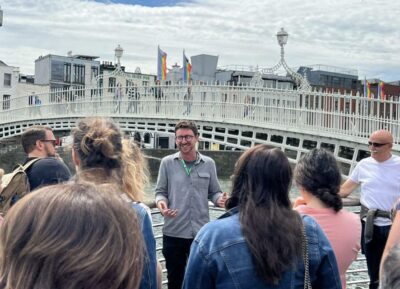
Browse the lists this tour appears in