
Reviewed · HISTORICAL TOURS
2-Hour Historical Walking Tour from Dublin
Two hours, and Dublin makes sense fast. This tour strings together Dublin’s big turning points in a small group with history postgraduates who explain the why behind the walls. You start opposite Trinity College Dublin, walk past key sites tied to education, empire, religion, and revolution, and then you still have the rest of the day on your own.
The one thing to think about is that the tour can feel politics-heavy. If you want only scenic culture stops and light storytelling, the subject matter may be denser than you expected, and you should expect to listen closely.
In This Review
- Key highlights you will care about
- Why This 2-Hour Dublin Walk Works So Well
- Starting at Trinity College Dublin (Grattan Statue): The Point of the Whole Trip
- Bank of Ireland and Temple Bar: Empire, Then Reinvention
- Wood Quay Amphitheatre: Viking Dublin, With Archaeology in the Foreground
- Four Courts and the Start of the Irish Civil War
- Christ Church Cathedral and City Hall: Invasions, Faith, and Emancipation
- Dublin Castle and the Name Dublin: King John to the Black Pool
- Guide Style: Why the Best Tours Feel Like a Story
- Timing, Walking Distance, and What to Do Right After
- Value Check: What $22.98 Buys, and What Costs Extra
- Should You Book This Dublin Historical Walking Tour?
- FAQ
- How long is the 2-Hour Historical Walking Tour from Dublin?
- Where do I meet my guide?
- Where does the tour end?
- Is the tour offered in English?
- Is the Book of Kells admission included?
- How many people are in the group?
- Can I get a refund if I cancel?
Key highlights you will care about
- Grattan statue start at Trinity College Dublin: easy to find, and you launch right into Ireland’s oldest university story
- Small group limit of 25: you get clearer explanations without being lost in a crowd
- History postgraduates leading: multiple guides are praised for clear voices, humor, and strong storytelling
- Short visits at famous landmarks: most stops are quick, and you can revisit on your own later
- No Book of Kells entry included: you get the context, but tickets are separate
Why This 2-Hour Dublin Walk Works So Well
This is a practical intro to Dublin because it compresses a lot of context into a tight time window. You plan for about two hours of walking and stops, and after that, you’re released into the city with better sense of where you are and what you’re looking at.
I also like the value math here. At around $22.98 per person, you’re not paying for a museum day. Instead, you’re paying for expert guidance that helps you decode major landmarks you would otherwise walk past with blank eyes. The pace is built for seeing a handful of places in a morning or afternoon, not for turning every stop into a long line item.
One more smart choice: the walking route ends at Christ Church Cathedral. That matters because you can keep moving right after the tour instead of backtracking.
More of Dublin crossed at walking pace:
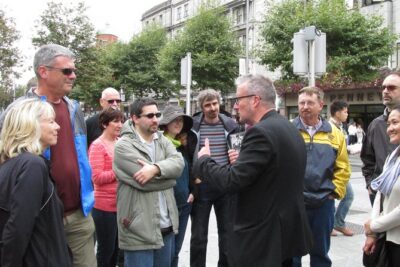
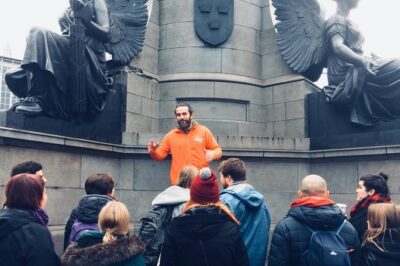
Starting at Trinity College Dublin (Grattan Statue): The Point of the Whole Trip
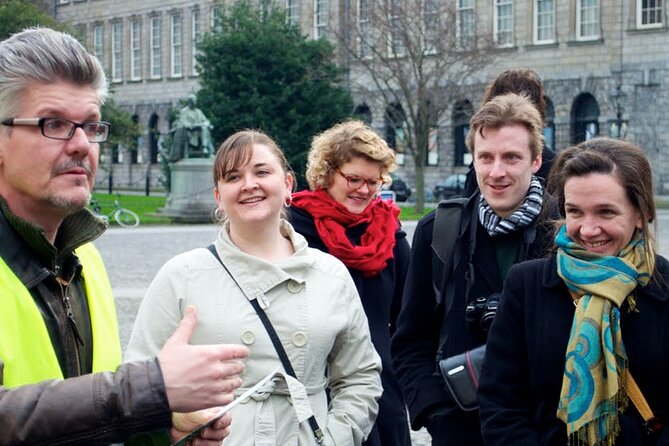
You meet opposite Trinity College Dublin at Henry Grattan Monument on College Green, near the front gate. From the start, the tour frames Trinity as a key piece of Ireland’s story, first with the simple fact that it’s the oldest university in Ireland, founded in 1592.
At this first stop, the guide also connects Trinity to the Book of Kells, an 8th-century manuscript of the four Gospels, written in Latin. Even though the Book of Kells entry is not included, you’ll still get the meaning behind it. That helps if you later choose to book your own timed ticket, because you’ll know what you’re actually looking for once inside.
Practical note: this is the stop where you’ll hear the most background. If you’re arriving tired, grabbing coffee before you meet is a good idea. The tour gets you oriented fast, and you’ll get more out of the rest of the walk.
Bank of Ireland and Temple Bar: Empire, Then Reinvention
After Trinity, you head to the Bank of Ireland, originally built as a colonial parliament in 1729. The explanation here is not just dates, it’s symbolism. You’ll learn how this building ties into the period of Protestant Ascendancy, especially through the 18th century, and how political change came with the Act of Union in 1800.
Then comes Temple Bar. In the tour narrative, it’s a reminder that cities evolve. This area of narrow streets was once earmarked for demolition, and later repurposed as Dublin’s Cultural Quarter in the 1990s.
Here’s what I like about this pairing: you’re seeing two sides of the same theme, power and then reinvention. The tour helps you notice how architecture and planning reflect who holds influence, and how that influence changes over time.
If you are hoping Temple Bar will be just about nightlife and streetscape photos, the tour will gently pull you toward its backstory instead. That’s usually a win, but it’s a consideration.
Wood Quay Amphitheatre: Viking Dublin, With Archaeology in the Foreground
Next is the Wood Quay Amphitheatre area, tied to archaeological excavations carried out in the 1980s. This stop matters because it connects Dublin to its older origins: the Viking city that was founded around AD 840.
What makes this stop feel real is the grounding in evidence. It’s not only legend. You get the sense that Dublin’s earliest layers were literally uncovered, then folded into the modern city we walk today. It’s a nice shift from political history into the physical roots of the city.
It also gives you something useful for the rest of your trip. Once you hear the Viking timeline, you’ll start spotting how old Dublin can still be felt underneath newer streets.
Four Courts and the Start of the Irish Civil War
At Four Courts, the tour turns from centuries-old foundations to the sharp edges of modern history. Four Courts is Ireland’s legal headquarters, and it’s also where a Civil War began in June 1922.
You’ll hear how that conflict split those who supported the Treaty of December 1921, versus those who opposed it. The guide’s job here is tough: keep the political logic clear without losing people in dates and factions.
This is one of those stops where the guide style makes the difference. In the best versions of this tour, you walk away understanding the basic cause and effect, not just memorizing events. One review highlighted that guides use humor alongside deeper points, which is exactly what you need for a subject like this.
If you prefer history with less politics, this is the stop where you might feel your patience tested. On the other hand, if you want context for Ireland’s later headlines and identity, this is key.
More of the rising and the years after:
- Dublin Historical Centre Food Tour with 8 Food Tastings & Drinks
★ 5.0 · 1,718 reviews - Historical 2-Hour Guided Walking Tour of Dublin
★ 4.7 · 865 reviews - Dublin to Cork, Blarney Castle & Cóbh Heritage Centre by train
★ 4.5 · 510 reviews - Dublin: Jeanie Johnston Tall Ship Irish Famine History Tour
★ 4.8 · 431 reviews
Christ Church Cathedral and City Hall: Invasions, Faith, and Emancipation
You then move to Christ Church Cathedral, Dublin’s oldest cathedral, founded in 1030. The explanation goes further into the 1170s rebuild in stone and the role of Strongbow, a central figure in the English invasion of the 1170s.
After that, City Hall brings you into Ireland’s religious and civic turning points with Daniel O’Connell, Dublin’s first Catholic Lord Mayor (1840). The focus here is his campaign for Catholic Emancipation in 1829 and the end of anti-Catholic laws, which is why he’s known as The Liberator.
This pair of stops is powerful because it spans different kinds of power. Christ Church is about conquest and rebuilding under new rule. City Hall is about political pressure and civil rights.
It’s also a good moment for you to ask questions if anything felt confusing. The history here connects so many later events, and a good guide can tighten the story right away.
Dublin Castle and the Name Dublin: King John to the Black Pool
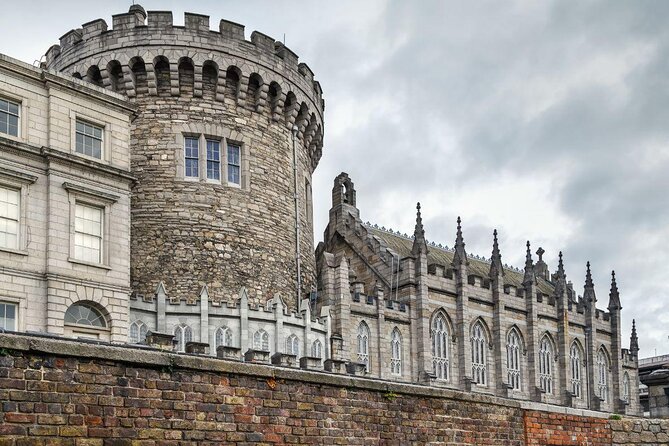
At Dublin Castle, the tour lands on British administration and the origins of the city’s name. You’ll hear that the castle began with King John in 1204 and that it served as the seat of British administration until 1922.
The tour also gives you the etymology of Dublin. It references Dubh Linn, the Black Pool, which is the name source for Dublin.
What I like about including this stop is that it answers a basic question you might otherwise ignore. Where does the name come from? Why is it connected to water? Instead of skipping over Dublin’s origin, you get the thread that ties the medieval site to modern identity.
Guide Style: Why the Best Tours Feel Like a Story
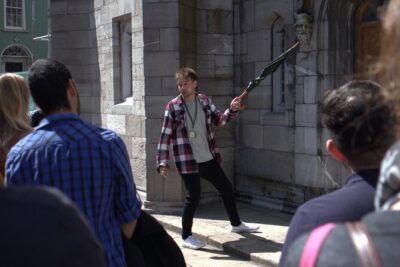
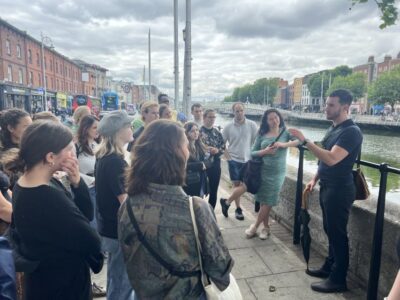
The guides are all history postgraduates, and that shows up in how they structure explanations. Many reviews praise guides for being easy to listen to, with clear voices and a balance of funny little stories and more detailed points.
You’ll also see that guides can be animated. People mention guides who bring the city to life with songs and stories, and others who manage the pace so you can follow along even when the weather is bad. Even if you don’t remember every date, you’ll remember the connections, which is what makes history useful.
You might get a guide like Caolan Maher, Daragh, Eoin, Jodie, Jody, John D., Colm, or Owen, based on guide names that have led tours in recent runs. The common thread is strong presentation, including humor to keep the material moving.
One careful note: because the tour is history-and-politics heavy, you’ll do best if you genuinely want the explanations. If you expected a mostly casual stroll with light background, you might find it more demanding than you hoped.
Timing, Walking Distance, and What to Do Right After
The tour runs about two hours, but I recommend planning for the possibility it could run a bit long. In one review, the tour went past the expected time by about half an hour. If you have a tight reservation right after, give yourself breathing room.
Dress for the weather. Ireland can go from fine to freezing fast, and some people in recent tours mentioned freezing conditions. Wear layers, bring a hat or hood, and use comfortable shoes. This isn’t a steep hike, but it is sustained walking and standing.
When you finish at Christ Church Cathedral on Christchurch Pl, Wood Quay, you’re placed well for the rest of your day. You can revisit stops you liked most, or you can pivot into nearby neighborhoods with a clearer mental map of what came before.
Value Check: What $22.98 Buys, and What Costs Extra
At about $22.98 per person, you’re buying a guided historical storyline plus access to a route of famous stops. Most of the landmark time is presented as quick visits and orientation, with no extra admission required at those sites.
The one notable cost detail is the Book of Kells. You won’t have entry included here. That’s actually helpful for you if you’re budget-minded. You can decide later whether you want to spend time and money on the exhibit after you’ve heard the context first.
If you love history, this tour usually feels like a bargain because it saves you from doing all the heavy thinking yourself. You come in knowing less, you leave knowing what matters, and you can choose how deep you want to go next.
Should You Book This Dublin Historical Walking Tour?
Book it if you want a strong introduction to Dublin that connects architecture to events, and events to identity. It’s ideal at the start of your trip, because it helps you understand why places look the way they do and why Ireland’s history is so tightly tied to politics, faith, and law.
Skip it or adjust your expectations if you prefer lighter, culture-only walking tours. This one is designed for people who can handle politics and timelines, and who like listening to a trained guide tell the story clearly.
If your goal is to leave Dublin with a factual backbone and a sense of where to go next, you’ll probably love it. Just wear warm clothes, bring comfortable shoes, and be ready to pay attention for two solid hours.
FAQ
How long is the 2-Hour Historical Walking Tour from Dublin?
The tour lasts about 2 hours.
Where do I meet my guide?
You meet at Henry Grattan Monument on College Green, Dublin, opposite Trinity College Dublin front gate.
Where does the tour end?
The tour ends at Christ Church Cathedral, Christchurch Pl, Wood Quay, Dublin (D08 TF98).
Is the tour offered in English?
Yes, the tour is offered in English.
Is the Book of Kells admission included?
No, entry to the Book of Kells is not included.
How many people are in the group?
The group maximum is 25 travelers.
Can I get a refund if I cancel?
Yes. Cancellation is free up to 24 hours in advance for a full refund. If you cancel less than 24 hours before the experience starts, the amount paid will not be refunded.
Just in from the Liffey side






Historical Tours, compared.

Dublin Historical Centre Food Tour with 8 Food Tastings & Drinks
Read our review →
Historical 2-Hour Guided Walking Tour of Dublin
Read our review →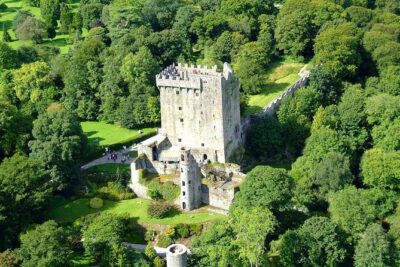
Dublin to Cork, Blarney Castle & Cóbh Heritage Centre by train
Read our review →
Jeanie Johnston Tall Ship Irish Famine History Tour
Read our review →

Deliciously Dublin: The Artisan Donut Walking & History Tour
Read our review →
Hidden Dublin: Haunted History Walking Tour v2.0 2026
Read our review →
Dublin Private Highlights & History of 1916 Easter Rising Tour
Read our review →Browse the lists this tour appears in