

Reviewed · HISTORICAL TOURS
Dublin: Medieval History Walking Tour
Medieval Dublin comes at street level. This 3-hour walking tour strings together Dublin Castle and cathedral stops with Viking-era stories you can actually picture as you walk. It is priced at $62 per person, and it works as a solid first look at the medieval core without needing a car or a packed itinerary.
I especially like how the walk starts behind Dublin Castle in Dubh Linn Gardens, where the city’s layered origins feel close and visual. I also love that your guide can tailor pacing and priorities, like Paula adjusting the day for a family with a stroller and even suggesting extra time at Trinity College and the Book of Kells exhibit if it fits your interests.
One thing to plan for: entry fees are not included, so if you want to go inside museums or add-ticket exhibits, your total cost can rise. Also, this is still a walk around central Dublin, so wear shoes you can trust on uneven streets.
In This Review
- Key Points Before You Lace Up
- Starting Outside Forbidden Planet, Then Turning Medieval Fast
- Dubh Linn Gardens to Dublin Castle, Where the Viking Story Gets Teeth
- Chester Beatty Library, A Museum Stop That Complements the Streets
- St Patrick’s Cathedral, More Than a Single Photo Spot
- Christ Church Cathedral, A Second Cathedral Lens on Medieval Dublin
- St Audoen’s Church and Its Old Bells, A Small Stop With a Specific Hook
- Cook Street Fortifications, Viking Influence You Can Spot
- Isolde’s Tower, Ending With Dublin Lore Instead of a Hard Stop
- Price and Value: What $62 Buys You in Real Terms
- When This Tour Makes the Most Sense for You
- Guide Quality Matters, and These Tours Lean on It
- Should You Book This Dublin Medieval History Walking Tour?
- FAQ
- How long is the Dublin Medieval History Walking Tour?
- Where do I meet for the tour?
- Is this tour private or shared?
- What languages are available for the live guide?
- What is included in the price?
- What is the cancellation policy?
Key Points Before You Lace Up
- Dubh Linn Gardens plus 13th-century Dublin Castle: start where the medieval story begins to feel real.
- Chester Beatty Library time: Alfred Chester Beatty’s collections bring texture to the whole “old Dublin” theme.
- Big-sight cathedrals: you see St Patrick’s Cathedral and Christ Church Cathedral in the same flow.
- St Audoen’s Church and its oldest bells: a small stop that adds a very specific, memorable detail.
- Viking-era echoes on Cook Street: you connect later medieval walls with earlier Viking influence.
- Flexible guiding style: guides like Paula and Catherine are praised for tailoring the day and keeping groups comfortable.
Starting Outside Forbidden Planet, Then Turning Medieval Fast
Meet outside the Forbidden Planet comic book store. It is a practical starting point, easy to find, and it sets the tone: you are not hopping between remote sites. You are moving through the center on foot.
From the start, the tour is built around a simple idea: Dublin’s medieval identity is not in one landmark. It is in the spacing between places. The guide helps you connect what you see outside with what happened here earlier, from early Viking activity onward.
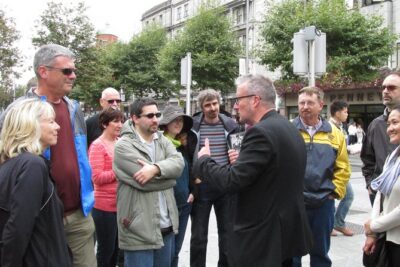
If you choose a shared group, expect a lively mix of people and pacing that can flex with the guide. If you want more control, a private group option is available, which is great when your schedule or interests are more specific.
More of Dublin crossed at walking pace:

Dubh Linn Gardens to Dublin Castle, Where the Viking Story Gets Teeth
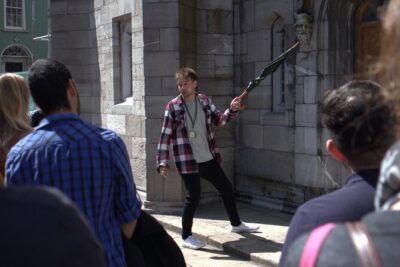
The first “wow” moment comes behind Dublin Castle at Dubh Linn Gardens. Even if you have seen photos of Dublin Castle, this approach makes it feel different. You are not just staring at stone from the front. You are getting the castle’s medieval context first, then meeting the fortress itself as the walk builds.
The guide will tell the early origin story of the city, including Viking conquests and how that changed Dublin’s trajectory. You will also learn what to notice on the castle grounds, including the fact that the fortress dates back to the 13th century, with a medieval tower that still reads like a time capsule.
I like this setup because it answers a basic question fast: why does Dublin’s medieval story sound the way it does? If you arrive in Dublin and feel like the city is just “pubs and traffic,” this start gives you a frame. You begin to see why power, defense, and religion grew where they did.
Practical tip: this part of the day can involve standing and looking at structures for a while. If you are bringing kids or you move slowly, this is a good time to ask the guide where you can pause and keep the group comfortable.
Chester Beatty Library, A Museum Stop That Complements the Streets
Next, you walk through the Chester Beatty Library area. Even if you are not a museum person, this stop makes sense on a medieval-history walk. Alfred Chester Beatty’s collection is described as one of Europe’s finest, and the vibe is calmer than the cathedral crowds.
This is also a nice rhythm change. After castles and fortifications, the library adds “human scale.” It reminds you that history is not only walls and kings. It is objects, documents, and the way people recorded and preserved the world.
Here is the balanced view: the tour does not promise you long, ticketed museum time unless you choose to add it. Since entry fees are not included, you should expect this stop to be more about orientation and what you can see as part of the walk. If you want a deeper museum session, you can budget for that separately.
If you like your history to have artifacts and context, this stop adds a lot for the price.
St Patrick’s Cathedral, More Than a Single Photo Spot
Then you reach St Patrick’s Cathedral, a major landmark tied to Ireland’s patron saint. The guide will point out how the cathedral’s façade and gardens create a sense of ceremony, even as you are walking through the city streets.
St Patrick’s Cathedral also works well as a “midpoint anchor.” It is big enough to feel impressive, but you are still in the heart of Dublin. The walk stays connected. You are not going from one far-away site to the next. You are gradually moving deeper into the medieval core while learning how religious influence shaped the city.
What I like here is the way the guide helps you read the place. Instead of just naming the building, you get stories about why a cathedral of this stature matters to Dublin’s identity, and how that identity shifted over centuries.
Drawback to consider: cathedral interiors and garden access can vary based on schedules. Since entry fees are not included, assume you might pay to go inside if you want that added perspective.
Christ Church Cathedral, A Second Cathedral Lens on Medieval Dublin
After St Patrick’s, you visit Christ Church Cathedral. Seeing two cathedrals back-to-back gives you a useful comparison. Even without getting lost in architectural terminology, you can feel how each place signals different eras and priorities.
This stop also helps you understand Dublin’s medieval religious landscape. When you stand in the center of the city and see how the sacred and the political overlap, the story becomes clearer. You are not just touring buildings. You are walking through the stage where power and belief were practiced.
If you have a moment of “I thought there was only one big cathedral,” this is why it is valuable to include both. It saves you from turning Dublin into a single-photo checklist.
More of the rising and the years after:
- Dublin Historical Centre Food Tour with 8 Food Tastings & Drinks
★ 5.0 · 1,718 reviews - 2-Hour Historical Walking Tour from Dublin
★ 5.0 · 875 reviews - Historical 2-Hour Guided Walking Tour of Dublin
★ 4.7 · 865 reviews - Dublin to Cork, Blarney Castle & Cóbh Heritage Centre by train
★ 4.5 · 510 reviews
St Audoen’s Church and Its Old Bells, A Small Stop With a Specific Hook
One of my favorite kinds of tour moments is the “one detail you will remember later.” St Audoen’s Church delivers that. You will hear about its role across Catholic and Protestant heritage, and you will learn about Ireland’s oldest bells tolling here.
That bell detail is the kind of fact that sticks because it is sensory. You do not just look at the building, you connect it to an audio marker of time. It also grounds the tour in the layered history of Dublin, where different communities have shaped the same urban spaces.
This is also a stop where pacing matters. If your group is restless, the guide can keep it moving. If people are attentive, you get time to absorb the meaning of the church and its long continuity.
Cook Street Fortifications, Viking Influence You Can Spot
After the cathedral and church cluster, you move toward Cook Street to see remnants of medieval fortifications. This is where the Viking threads start paying off in a very practical way.
The tour ties earlier Viking influence to the later medieval defensive footprint. That connection matters because it turns “Vikings” from a distant textbook word into a concrete influence on city layout and defenses.
I like Cook Street for another reason too: it is a reminder that medieval Dublin is still in the streets, not only inside major landmarks. You get a sense of how the city’s survival strategy shaped the modern streetscape.
Practical tip: take a second to look at the street edges. Remnants can be subtle. If you rush, you might miss the details your guide is pointing out.
Isolde’s Tower, Ending With Dublin Lore Instead of a Hard Stop
The walk finishes at Isolde’s Tower, an iconic medieval building steeped in Dublin’s lore. This ending matters because it shifts the mood. You are not just closing with another “must-see” structure. You are closing with a story you can carry around, a piece of legend anchored in stone.
I like this kind of finish because it helps the tour feel like narrative, not like a list of stops. By the end, you have moved from origins and conquest stories into religious power, then into defense and survival, and finally into local legend.
Also, returning back to the meeting point keeps the logistics simple. No transfer, no confusion, no hunt for a rideshare at the end of a long walk.
Price and Value: What $62 Buys You in Real Terms
$62 for a 3-hour guided walking tour is a fair price for a city-center history route, especially because it includes a live guide and a clear set of major medieval anchors.
Here is how to think about value:
- You are paying for interpretation. The guide’s job is to turn Dublin Castle, St Patrick’s Cathedral, and Christ Church Cathedral into connected meaning.
- You get focused time. Three hours in central Dublin is enough to cover the key sites without turning your day into a marathon.
- You can choose your group style. Shared group is a lower-cost way to get a guide, while private group adds flexibility if you have family needs or specific interests.
What is not included is just as important: food, drinks, and entry fees. So the true cost depends on what you decide to add. If you want museum-style depth at places like Chester Beatty Library or you add ticketed exhibits, budget extra.
A nice touch from guide stories: Paula and Catherine are praised for matching the day to real needs. One family with a 2-year-old and a stroller appreciated flexibility, including adjusting pace and even mapping in extra interests like the Book of Kells at Trinity College when it fit.
That kind of guide responsiveness is hard to price, but it is a big part of why this tour scores well.
When This Tour Makes the Most Sense for You
This is best for you if:
- You want a medieval-focused orientation to Dublin quickly, without hopping across town.
- You like history told as stories tied to specific locations, not just dates.
- You value a guide who adjusts pace for different group needs, including families.
It is also a smart choice if this is your first Dublin day. The sites are central, and the narrative connections help you explore on your own later. You will walk away with better instincts for what to visit next and what you might skip.
If you already have a deep architectural hobby and you want hours inside every building, you might need to add extra self-guided time or ticketed entries beyond this walking-focused format. The tour is designed for the street view plus guided context, not for a full museum day.
Guide Quality Matters, and These Tours Lean on It
The most consistently praised element is the guide experience. Paula and Catherine both come up for being friendly, story-forward, and packed with historical facts and tales as you move around.
Two practical signs you will likely feel during the tour:
- The guide can adapt the plan. One group used time planning their day with a short coffee break and then adjusted how they wanted to spend it. That is real-world helpful when you have energy levels to manage.
- The guide listens to interests. That same example included encouragement to experience the Book of Kells exhibit after discussing preferences and background. Even if your tour route stays centered on the medieval core, your guide may suggest nearby options if time allows.
In short, this is not a script read at you. It is a guided walk with room for your questions and preferences, which makes the $62 feel more like paying for a personal city lens than for a stamp.
Should You Book This Dublin Medieval History Walking Tour?
Yes, I think you should book it if you want a guided, story-based introduction to medieval Dublin with major landmarks grouped efficiently in one 3-hour walk. The value is strongest when you treat it as the foundation for your day, not the only history stop you make.
Skip booking only if you know you will be irritated by lots of walking, or if you strictly want ticketed interior time at every site. Since entry fees are not included, you may end up spending additional money if you decide you want to go inside more places than the walk covers.
If you do book, do one simple thing that improves the experience immediately: wear solid shoes and bring your curiosity. Dublin’s medieval past is right there in the stone and the street edges, and a good guide turns it into a story you can actually follow.
FAQ
How long is the Dublin Medieval History Walking Tour?
The tour lasts 3 hours.
Where do I meet for the tour?
You meet outside the Forbidden Planet comic book store.
Is this tour private or shared?
You can choose either a shared group tour or a private walking tour (private group available).
What languages are available for the live guide?
The tour guide is available in English, French, Spanish, and Italian.
What is included in the price?
The tour includes a private or shared group walking tour and a guide. Food or drinks and entry fees are not included.
What is the cancellation policy?
Free cancellation is available up to 24 hours in advance for a full refund.
Just in from the Liffey side






Historical Tours, compared.

Dublin Historical Centre Food Tour with 8 Food Tastings & Drinks
Read our review →

Historical 2-Hour Guided Walking Tour of Dublin
Read our review →
Dublin to Cork, Blarney Castle & Cóbh Heritage Centre by train
Read our review →
Jeanie Johnston Tall Ship Irish Famine History Tour
Read our review →

Deliciously Dublin: The Artisan Donut Walking & History Tour
Read our review →
Hidden Dublin: Haunted History Walking Tour v2.0 2026
Read our review →Browse the lists this tour appears in