
Reviewed · WALKING TOURS
All Dublin 3 hours italian walking tour
Three hours in Dublin, with a plan. This All Dublin 3 hours Italian walking tour is a fast, well-organized route that hits the city’s headline landmarks plus the little details you would miss on your own. I especially liked starting at the Molly Malone statue, since it instantly gives you a Dublin personality, and I also liked the dessert or coffee stop in a historic bakery setup. The only real drawback is the pace: you move quickly from place to place, so it is not built for long, slow museum-style wandering.
What makes it work is the guide. You get a licensed, Failte Ireland certified guide, and when the guide is Elisa, reviews highlight that her Dublin storytelling is friendly and well prepared. You also get short photo pauses and enough breaks to catch key shots without feeling rushed nonstop, even though the overall timing is tight.
Finally, it runs on foot and it can operate in wet weather up to a yellow alert, so you will want to be ready. Bring comfortable shoes and a poncho, not an umbrella, because the walk stays steady.
In This Review
- Key points before you go
- First stop: Molly Malone on Suffolk Street, and why it is a smart opener
- Trinity College and the Book of Kells connection, in quick snapshot form
- Temple Bar, up close: pubs, streets, and the area’s shift over time
- Ha penny Bridge and Dublin Castle: two stops where the city looks staged, then explains itself
- St Patrick’s Cathedral: medieval architecture and the St Patrick legend angle
- Viking Dublinia: how the tour makes Vikings feel relevant
- Christ Church Cathedral: where the walk lands, and how it ties the story together
- The Liberties and the Guinness family: the beer story with an actual 1759 anchor
- Dessert or coffee in an old bakery: included, but still flexible
- Pacing, weather, and what to bring so you enjoy every stop
- Language and guide style: what Italian might mean for your experience
- Price and value: is $28 worth it?
- Should you book this Dublin Italian walking tour?
- FAQ
- What is the duration of the All Dublin Italian walking tour?
- How much does it cost?
- Where do I meet for the tour?
- What time does the tour start?
- Is the tour guided in Italian?
- Is dessert or coffee included?
- Are there breaks for photos?
- What should I bring?
- Can the break stop accommodate allergies or intolerances?
- Where does the tour end?
Key points before you go
- Start at Molly Malone (Suffolk Street), then get oriented fast with stories tied to famine and emigration.
- Trinity College, quick but meaningful, including context around the Book of Kells connection.
- Temple Bar in daylight with history, plus a walk that explains how the area changed over time.
- Viking Dublin with Dublinia and a clear link to how Vikings shaped Irish culture and tradition.
- Arthur Guinness and the 1759 tie-in, explained as part of how Dublin became Dublin.
- Dessert or coffee included, chosen based on availability, with help for allergies where possible.
First stop: Molly Malone on Suffolk Street, and why it is a smart opener
The tour meets at the Molly Malone Statue on Suffolk Street Dublin 2. It is a very “Dublin” place to begin, because the statue is not just decoration, it is a story point. You get a short guided intro on who Molly Malone is and how her legend links to Ireland’s mid 1800s famine and emigration.
That opener matters because it sets the tone for the entire walk. Instead of treating Dublin as a list of sights, you start seeing how people, hardship, and identity show up again and again in the city’s landmarks. It is also an easy meeting point for first time visitors, since it is right in the central area.
You will spend about 10 minutes there with a guided tour. That is long enough to get the meaning, short enough to keep momentum.
More of Dublin crossed at walking pace:
Trinity College and the Book of Kells connection, in quick snapshot form
After Molly Malone, you head to Trinity College Dublin for a photo stop and a short guided segment. Trinity is Ireland’s oldest university, and the tour frames it as a place where truth and legend can blur a bit, which is exactly how it often feels in Ireland when you mix recorded history with local storytelling.
The highlight here is the reference to the Book of Kells, one of the world’s most famous illuminated manuscripts. The tour does not suggest you will linger for hours inside, but you do get enough context to understand why this university is a cultural magnet.
If you are hoping for a slow, in-depth campus visit, this might feel brief. But for a 2.5 hour overview walk, this is a good use of time because it places the famous name into a Dublin story you can carry with you.
Temple Bar, up close: pubs, streets, and the area’s shift over time
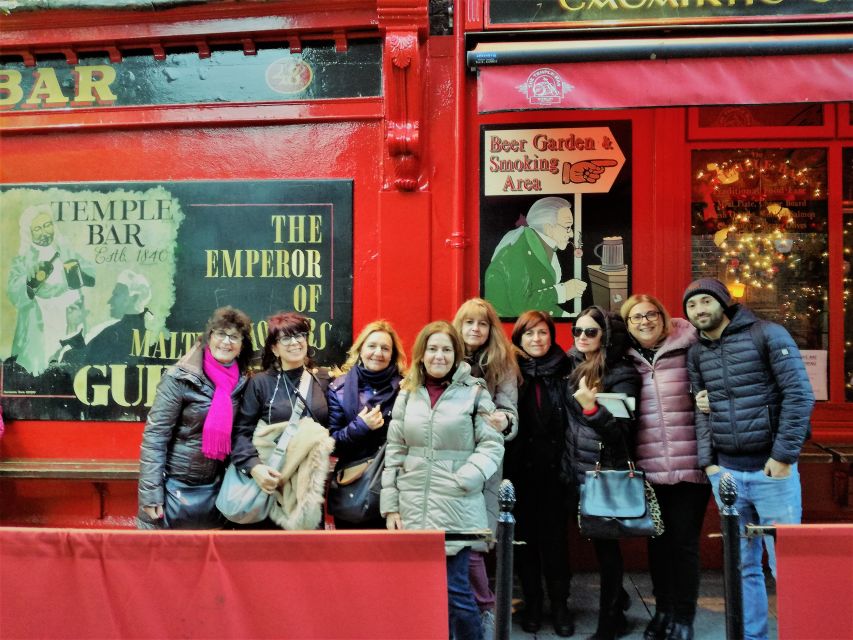
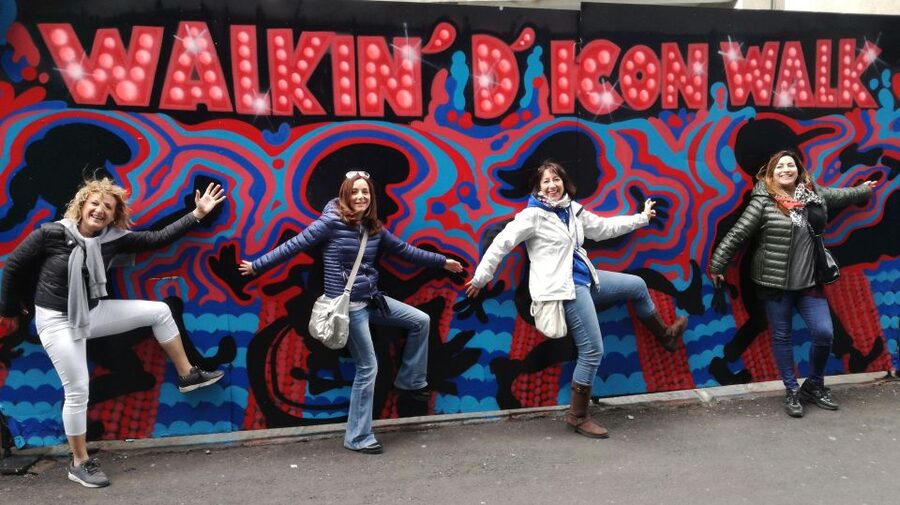
Next comes Temple Bar. You get another photo stop plus a guided walk and explanations about how the area evolved. Temple Bar is the kind of neighborhood people already think they know, but the tour approach helps you separate what the postcards say from what the streets actually mean.
You will be walking among pubs and picturesque clubs, and the guide focuses on the neighborhood’s development over the years. Even if you plan to come back later, this first pass helps you understand which parts of Temple Bar are classic Dublin energy and which parts are more about visitor expectations.
One practical note: Temple Bar streets can be crowded at peak times. Since this tour starts in the morning, you usually get a calmer feel than late evening, which is a nice bonus for photos and for hearing the guide. The stop is set for around 10 minutes, so it is not meant to be a long pub crawl, just a guided walk through the vibe.
Ha penny Bridge and Dublin Castle: two stops where the city looks staged, then explains itself
Then you hit Ha penny Bridge for photos and a short guided segment of about 5 minutes. This is one of those places where you get the postcard view quickly, then the guide gives you the context that turns it from a pretty bridge into a Dublin landmark with a history you can talk about.
From there you move to Dublin Castle for a photo stop and about 15 minutes of guided time. Dublin Castle is a key stop for understanding how the city’s political power worked, and why modern Dublin grew up around older institutions. In a short format, you will not get every chapter, but you do get enough to connect castle walls, power, and the rhythms of the city around it.
If you hate rushing, this section may feel like “look, listen, move.” Still, the time allocation is realistic for a walking tour that also wants to cover cathedrals and Viking history.
St Patrick’s Cathedral: medieval architecture and the St Patrick legend angle
After Dublin Castle, the tour moves to St Patrick’s Cathedral. You get another photo stop with guided time of around 15 minutes. St Patrick’s is presented as one of the few examples of medieval architecture in the capital, and the guide also brings in legend and local storytelling.
You also hear about the patron saint of Ireland and a legend tied to Ireland as the island associated with the Emerald theme. The tour does not frame it as a purely academic history lecture, it frames it as the kind of story Dublin repeats because it shapes how people talk about their roots.
This is a good stop for you if you like your history with atmosphere. It is also a solid midpoint check, because you have now seen Trinity’s modern fame, Temple Bar’s nightlife reputation, and the castle’s authority. St Patrick’s adds spiritual and architectural depth without requiring a long indoor stay.
Another way the same day could go from Dublin:
- Dublin to Cliffs of Moher, including Wild Atlantic Way and Galway
★ 5.0 · 23,331 reviews - From Dublin: Cliffs of Moher, Burren & Galway City Day Tour
★ 4.8 · 18,888 reviews - Dublin: Guinness Storehouse Entry Ticket
★ 4.6 · 16,863 reviews - Dublin to Cliffs of Moher, Burren, Wild Atlantic Way, Galway Tour
★ 5.0 · 12,924 reviews
Viking Dublinia: how the tour makes Vikings feel relevant
Then you get to Dublinia for a photo stop and about 10 minutes guided. This is where the tour leans into Viking influence, and it aims to connect it to Irish culture, history, and traditions. You will hear about Viking presence and how that influence shows up in what Dublin became.
This stop is one of the best value points in the itinerary because it gives you a different Dublin angle from the standard pub and cathedral route. Even with limited time, you come away with a sense of why Viking-era history is not just a distant chapter. It is part of Dublin’s identity.
The tour also uses the surrounding stops, especially the cathedral segment, to keep the Viking thread consistent. So you are not jumping between unrelated topics.
Christ Church Cathedral: where the walk lands, and how it ties the story together
Near the end, you reach Christ Church Cathedral for a photo stop and about 15 minutes guided time. Christ Church is presented alongside Viking context as the first cathedral of Dublin, with explanations that connect it to the earlier story themes in the route.
This final stretch works because the tour has already built your framework. You have seen Irish identity through Molly Malone, institutional Ireland through Trinity, nightlife culture through Temple Bar, power through the castle, faith and medieval architecture through St Patrick’s, and Viking influence through Dublinia. Christ Church then becomes the place where those threads meet in one central location.
One small thing to check: the tour notes say it ends at Christ Church Cathedral, while the general activity info also says it ends back at the meeting point. In practice, for a walking tour with a central route, you may finish very close to the meeting area. Your booking confirmation will clarify the exact end point.
The Liberties and the Guinness family: the beer story with an actual 1759 anchor
The itinerary also includes time walking in the Liberties area, described as Saint Patrick’s Cathedral area and where Arthur Guinness opened his activity in 1759. That is an important detail because it gives you a timeline, not just a nickname. Guinness is loved everywhere now, and the tour uses that love to explain how the family became part of Dublin’s story.
This section is also where the tour’s “local tips” vibe fits naturally. When you talk about Guinness history while walking the neighborhoods tied to it, it feels less like branding and more like city memory.
If you want to plan what to drink or where to eat later, this is the best part of the tour to listen closely. The guide’s restaurant, pub, and music pointers are more likely to match the real neighborhoods you are standing in.
Dessert or coffee in an old bakery: included, but still flexible
A highlight of this tour is the dessert or coffee tasting stop in one of the oldest bakeries in the city. You get it based on availability, and it is included. The tour also says the guide is happy to meet needs for allergies and intolerances where possible at the places chosen.
This is not a tiny afterthought. In a short walking tour, one break can decide whether you feel fresh at the end or tired and cranky. Also, eating something local during a guided route tends to make the city feel real in a way “just looking” never does.
The only consideration is timing. Because it is based on availability, the exact item you get can vary. But you should still plan on a proper rest stop, not just a quick snack.
Pacing, weather, and what to bring so you enjoy every stop
The tour is listed as 2.5 hours, with multiple stops that each run roughly 5 to 15 minutes. That makes it ideal for a first visit, because you cover major attractions without burning half the day. It is also a reason to manage expectations: you will not get “see everything in depth,” you get “see the important things and understand the story.”
Because it runs with weather conditions up to a yellow alert, rain is possible. You are advised to bring a poncho, which is usually easier than an umbrella on city sidewalks. Comfortable shoes are non negotiable. You will be on foot for most of the tour.
You might also want to bring a phone with battery power for photos, because several stops are photo focused. The tour explicitly builds in breaks so you can take pictures without feeling like you are holding up the group nonstop.
Language and guide style: what Italian might mean for your experience
The tour is in Italian. If Italian is your comfort zone, you will likely enjoy how the guide weaves legend, architecture, and street life into one story. If your Italian is basic, you can still follow the main ideas from the visuals and the landmark names, but you may miss some of the nuance.
The tour emphasizes certified guiding, so you should feel confident you are getting facts plus story context rather than random chatter. Reviews also bring up that guides like Elisa are described as friendly, prepared, and passionate about Dublin stories.
Price and value: is $28 worth it?
At $28 per person for about 2.5 hours, this tour is priced like a solid “high value overview.” You are paying for three big things:
- a licensed, Failte Ireland certified guide
- a route that covers multiple major sights in central Dublin
- an included dessert or coffee break
If you were to do the landmarks on your own, you could save money, but you would likely spend time figuring out what connects each place. The guide’s job is to connect the dots fast, from Molly Malone to Trinity, then Viking history, cathedral context, and Guinness origins.
So I think it is worth it if you want orientation and story. It might not be worth it if you already know Dublin well or if you prefer long stops and independent exploration.
Should you book this Dublin Italian walking tour?
Book it if you are:
- visiting Dublin for the first time and want a fast map of the city
- interested in stories that connect people, legends, and history
- traveling with Italian language comfort and want guided context
- happy with a photo stop style, plus a dessert or coffee break
Skip it or pair it with something else if:
- you prefer slow paced exploring and long time at each site
- you want deep museum level time, not quick guided explanations
- your group needs lots of flexibility in timing, since the schedule is built around short guided windows
If you want a practical introduction that helps you plan the rest of your Dublin days, this is a good call.
FAQ
What is the duration of the All Dublin Italian walking tour?
The tour duration is about 2.5 hours.
How much does it cost?
The price is $28 per person.
Where do I meet for the tour?
You meet at the Molly Malone Statue on Suffolk Street, Dublin 2.
What time does the tour start?
The tour starts at 10:00 am. The activity info also says you should check availability to see starting times.
Is the tour guided in Italian?
Yes, the live guide leads the tour in Italian.
Is dessert or coffee included?
Yes. A dessert or coffee is included based on availability at the stop chosen.
Are there breaks for photos?
Yes. The tour includes sufficient breaks so you can take photographs.
What should I bring?
Bring comfortable shoes and comfortable clothes. A poncho is recommended, and it is suggested to show up about 5 minutes early.
Can the break stop accommodate allergies or intolerances?
The guide says they will be happy to meet allergy and intolerance needs where possible at the places chosen for the break.
Where does the tour end?
The activity info says it ends back at the meeting point, while the itinerary says it finishes at Christ Church Cathedral. Your confirmation should clarify the exact end location.
Just in from the Liffey side





Walking Tours, compared.
Dublin Highlights and Hidden Gems Guided Walking Tour
Read our review →
90 Minute Dublin Walking tour and Sightseeing tips
Read our review →

Historical 2-Hour Guided Walking Tour of Dublin
Read our review →
Dublin Traditional Irish 3 Course Meal Walking Tour with Local
Read our review →
Browse the lists this tour appears in